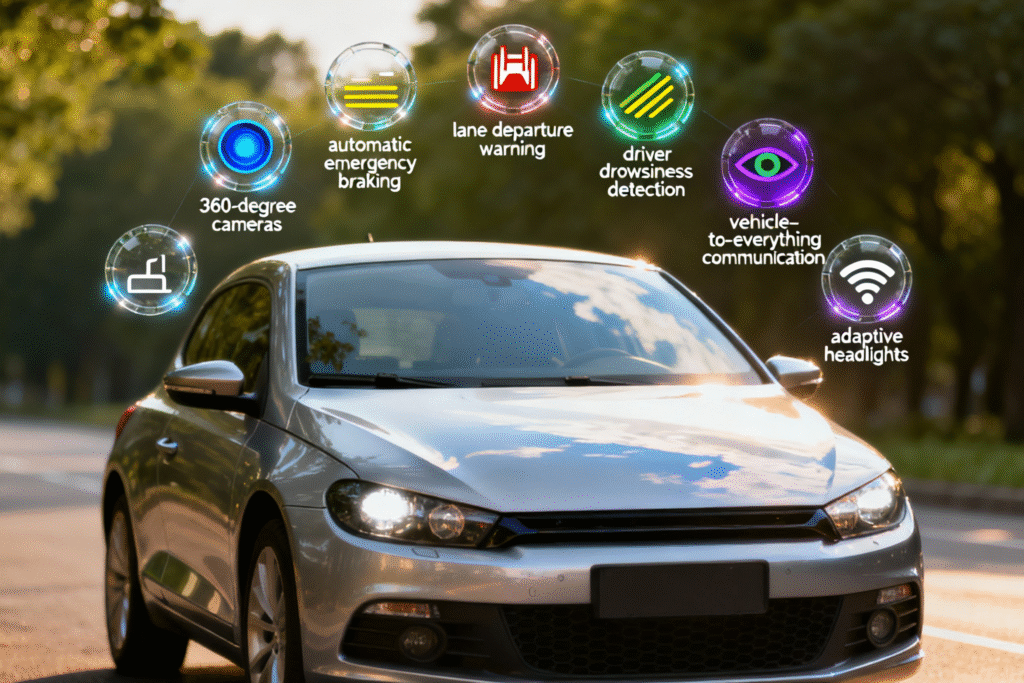
Modern vehicles have extraordinarily progressed. They are no longer simple mechanical systems, but intelligent technologies designed to assist passengers and diminish accidents; moreover, their design largely focuses on preserving pedestrians’ safety. Today, the array of driver‑assistance systems, sensors, input technologies and AI‑based solutions helping for security is truly striking, as documented in the vast majority of India autos and car update news. Safety is the main direction of development for manufacturers because it is connected to the progressive increase of the wisdom of drivers and workers regulating the sphere. Thus, there are 7 groundbreaking technologies ensuring safer driving experience and implemented in the most recent updates of vehicles. Every technology in question is pivotal and constitutes one more link in the chain of reliable protection of the driving environment, especially, in the context of automobile latest updates delivered by the authors of numerous India autos.
ADAS and Its Contingent Systems
ADAS’s importance for Indian drivers is impossible to overestimate; specifically, the introduction of ACC, LKAS, BSD and AEB into modern vehicles largely decreased the frequency of human error, which is the main cause of most collisions on roads. ADAS employs radar, sensors and cameras located all over the vehicle. By observing the surroundings, these devices activate once an obstacle comes into their observed area. Every time the analysis of the driving environment as such and the threat within it reveals the potential occurrence of an emergency, ADAS tries to counteract it. As for the recently launched auto models in India, all of them contain Level 2 ADAS, with such systems providing partial automation of the driving while the attention of the driver remains crucial for higher efficiency. In the modern world, such an approach to security is definitely beneficial; therefore, ADAS technology becomes a unique part of the vehicles offered for sale. Many brands such as Hyundai, Honda, Tata Motors already develop cars of a wide spectrum of segments with the integrated ADAS; some convenient models containing the system can be used for traveling or work. The introduction of such technologies will facilitate smoother traffic and the lesser number of fatal collisions, which is a nice vector for improving the safety of the state.
Automatic Emergency Braking (AEB)
Automatic Emergency Braking (AEB) is one of the most critical technologies in modern vehicles. It operates using radar and vision sensors that detect imminent collisions and brake automatically when the driver fails to react. This feature reduces the event of crash or, in some cases, even prevents them. Safety authorities such as the Euro NCAP and Global NCAP acknowledge the relevance of the AEB feature, making it a mandatory requirement for achieving high safety ratings. The most recent automobile updates announce its inclusion in more Indian vehicles, particularly in the mid-tier variants.
AEB, besides helping the driver in a crisis, ensures that the car consistently behaves as an “intelligent” partner for safety. When combined in multiple layers with other safety tech such as pedestrian protection sensors and 360‑degree cameras, AEB makes the road far safer than most drivers assume when they read their car update news. As the greatest hazard today is the road itself, increasingly comprised of other vehicles, safety tech is fast becoming a need for anyone who uses an automobile.
Driver Monitoring Systems (DMS)
Driver distraction and fatigue are among the leading causes of road events worldwide. Driver Monitoring Systems features cameras, infrared sensors, and AI algorithms that determine when a driver is getting drowsy or not paying enough attention to the road. When the eyes of the driver start drooping below halfway to closed, the system alerts the driver by beeping or through a gentle vibration to get their attention. Most of the time, these systems are crucial for long highway drives where there is a humbling sameness in everything that is likely bound to keep any driver weary and bored. More car news sites have received multiple reports indicating that many new and apt buyers in a city like India are interested in these alerting systems as they also functional for a fleet operator.
Vehicle‑to‑Everything Communication
Vehicle‑to‑Everything communication is a novel solution that takes safety to an entirely networked level. With V2X, vehicles can interact with infrastructure, pedestrians, and even other cars using wireless communication. Specialized mechanisms that continuously send and receive data from a centralized server transmit road hazards, weather alerts, traffic signal timing, or sudden braking ahead. By knowing everything that is happening on the road in real time, drivers can adjust their speed and distance, which allows them to make informed decisions.
In countries as densely populated as India, whose auto industry update can hardly be absorbed at the same rate by its infrastructure, it is impossible to overestimate the potential of this feature. Car safety latest update trends actively seek to incorporate V2X communication, as the connectivity and smart city industry rise. A V2X‑enabled car will warn the driver that an ambulance is approaching or construction works are underway long before they become visible on the road. By knowing this information in advance, which excludes any possibility of missing it, the roads can become much more orderly and efficient.
Adaptive Headlights and Night Vision Systems
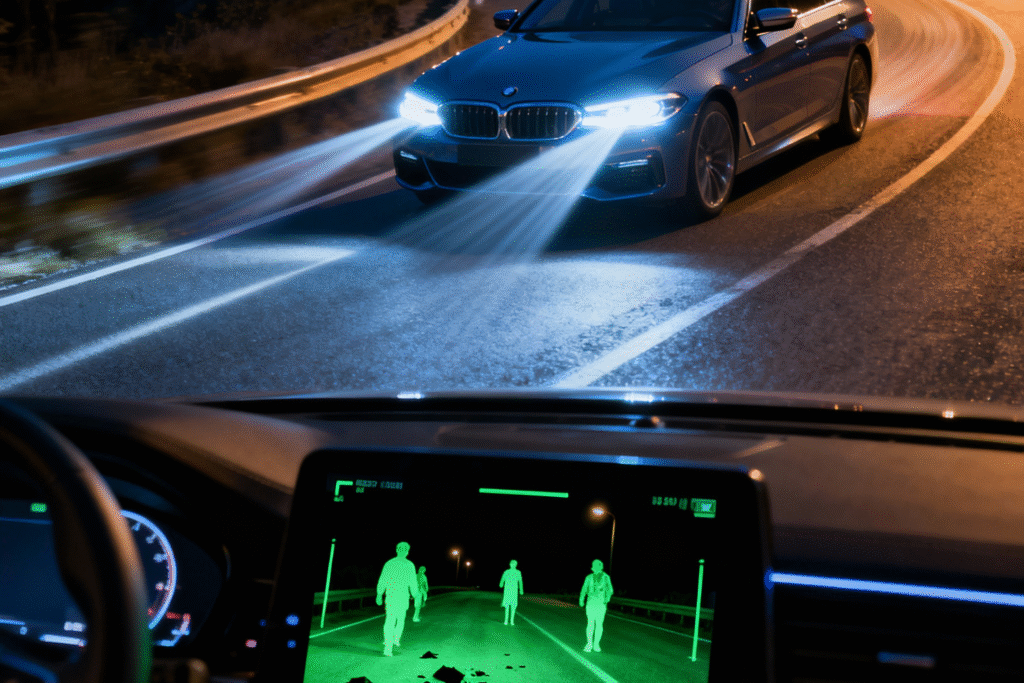
In accordance with expert driver safety update tips, poor nighttime visibility is the leading cause of road accidents. Adaptive headlights automatically adjust the light beam’s shape and intensity depending on the vehicle’s speed, steering wheel direction, and road topography, both reducing risks and increasing visibility. Night Vision Systems use infrared sensors to pick up pedestrians, animals, or obstacles that are too far for the headlights’ high beams. This information is displayed on the dashboard, increasing the driver’s reaction time. Premium SUVs and electric cars are equipped with this feature, as the vehicle latest news today emphasizes the importance of adaptive light for rural and highway driving. Indian motorists are particularly appreciative of adaptive light since poor visibility proves to be the leading cause of summer road accidents.
Electronic Stability Control System (ESC)
ESC is a safety innovation that has proved to be highly beneficial as it helps keep the car stable during sharp turns or sudden maneuvers. By automatically applying brakes to individual wheels, ESC reduces the possibility of skidding and the car going out of control. Although it is standard in most major global markets, the automotive sector of India or which sit top position of latest auto industry updates has only recently been taking an interest in this system due to the growing population of cars.
ESC is especially beneficial on such surfaces as slippery roads. India is notorious for rough, uneven road surfaces which become all the more treacherous during the rainy season. It is going to be mandatory on all new passenger vehicles in the upcoming years. From the perspective of smooth road navigation, the system is beneficial because it prevents spinouts and crashes which may block one or more lanes at a major junction. It is extremely reliable and low-maintenance and as such, would be a part of any digital driver aids’ style tech that would continue to endure.
Artificial Intelligence and predictive safety analytics
AI is the invisible behemoth that guards the modern car. Using real‑time data from cameras, sensors and car monitor records of popular driving standards used worldwide, toiled AI systems will make predictions decades before an actual accident. For example, if a vehicle’s adaptive cruise control detects sudden change in driving, AI algorithms will soon predict the possibility of braking at certain ranges and prepare safety measures. It will also enable predictive alerts to check the vehicle’s brakes and tire treads.
When these merits accrue to the side of total vehicle maintenance, it should be added that alerts about tires are also given via in-car AI style tech. Some manufacturers go even further and connect in-car AI with networked servers to enable the cars to share each other’s safety information. Such in-car system or globally networked AI will all be able to predict environmental calamities such as waterlogging or potholes using real‑time satellite footages. To sum up the argument it may be said that cars will soon be able to predict hazardous routes thus making road more journey worthy at the right moment.
The Cumulative Impact of Technological Integration
While each of these innovations improve safety independently, the true value lies in their integration. Companies already build safety ecosystems that allow their technologies to talk to one another—connecting a car’s braking systems to its navigation data, or its driver monitoring inputs to adaptive controls, for example. The end result is a vehicle intelligence network which not only coordinates to protect occupants from accidents but also pre-empts challenges prior to them becoming a threat.
This comprehensive approach is a significant paradigm shift for both automobile security and digital intelligence. Companies that invest to combine a robust sensor fusion and AI analytics backend standardize their field, determining the thresholds of safe driving. By complementing ADAS, AEB, DMS, and V2X capabilities, cars will progress from passive safety to active anticipation of accidents, which will significantly decrease the likelihood of human errors or road rage-related hazards.
The State of Indian Roads and the Traffic Safety Revolution
The Indian automotive sector is critical to addressing this evolving road context. Both local demand and government policies allow technology providers and automobile manufacturers to invest heavily in these field trials. According to leading experts who provide the latest automobile industry news, it will not be long before AI and sensors begin appearing in even the mid-range automobile spectrum.
It is crucial to note, nevertheless, that this particular evolution marks a significant milestone on the road to democratizing safety features. Previously, only premium vehicles with ADAS or AI-based technologies had access to these systems. Now, with innovations tailored to the Indian manufacturing market, these once exclusive technologies can be accessed by a wider group of people. Furthermore, V2X technologies and networking backends will not be isolated in vehicles but spread to the entire national road network as more AI-enabled vehicles become integrated. Manufacturers are already carrying out campaigns that raise awareness about road discipline and technology use. Technologies that are trusted and well-known by the masses naturally spread more quickly. It’s an encouraging development in line with the existing national focus on driving up road safety standards.
AI platforms are doing outstanding work in this ongoing technological revolution by bridging a gap between predictive algorithms, vehicle data, and human decision-making. The role has become vital because today’s AI systems or deep learning models and data analytics can understand live driving conditions to assist a driver and drastically reduce error margins. Platforms like justdrive.ai work in partnership with automotive developers and OEMs to continuously refine machine learning systems trained on millions of driving scenarios. The optimisations for one vehicle can directly benefit the entire community by controlling fewer accidents, reduced traffic congestion, and retained awareness among all road users. In addition, AI-based safety frameworks installed in the vehicles drive smarter fleet operations along with improved on-site insurance risk assessments. In simple terms, a smart vehicle assist fleet owners track acceleration patterns, scan live images for road signs, and gauge a situation when a vehicle would require preventive maintenance for better and more efficient logistics.
Faith on smart vehicles makes us confident about a safer-driving future on Indian roads, and people are demanding more and more safety features in their new vehicles. The way we are stepping ahead for the next automobile update cycle in connectivity and sustainability, the future would see more AI support like sensor data, high-speed communication, and data processing via cloud-based safety models instead of current piece-meal installations. Hundreds of thousands of sensors and HD cameras will send this data to AI models, and perhaps the journey will reach many unimaginable, predictive, and life-saving decisions for vehicles to mitigate accidents. Soon the automobile industry would go to software update cycles to ensure vehicle autonomy. Instead of passive safety, vehicles will proactively predict, prevent, and bolster safety for every driver onboard. Many are buying new cars based on star safety ratings in India, and the trend goes parallel with performance, mileage, and comfort. The country is fully conscious of the initiative to highlight safety features, and that ensures all manufacturers innovate in this space by design. More importantly, the nation would see bolstering of 5G networks and greater AI data processing capabilities encouraging roadside, localised data processing. Very soon, a vast majority of vehicles would be intelligent, data-driven partners with the responsibility of smart learning, acting, and safeguarding every journey.
FAQs
- What are the key car safety technologies improving road safety in India?
The major technologies include Advanced Driver Assistance Systems (ADAS), Automatic Emergency Braking (AEB), Driver Monitoring Systems (DMS), Vehicle-to-Everything (V2X) communication, Adaptive Headlights and Night Vision Systems, Electronic Stability Control (ESC), and Artificial Intelligence-based predictive safety analytics. These collectively enhance driver awareness, vehicle control, and accident prevention.
- How does ADAS contribute to safer driving in Indian conditions?
ADAS uses radar, cameras, and sensors to detect obstacles and assist with lane keeping, adaptive cruising, and collision avoidance. Level 2 ADAS, increasingly present in Indian models like those from Hyundai, Tata, and Mahindra, helps reduce human errors, which are the leading cause of road accidents in India. - Why is Automatic Emergency Braking (AEB) becoming essential in new vehicles?
AEB automatically applies brakes when a potential collision is detected, reducing accidents caused by delayed driver reactions. It has become mandatory for high safety ratings globally and is now appearing widely in mid-tier Indian vehicles, providing an intelligent safety backup. - What role do Driver Monitoring Systems play in road safety?
DMS track driver alertness using cameras and AI. By detecting drowsiness or distraction, these systems alert drivers, helping prevent accidents due to fatigue, especially during long highway drives—a critical feature appreciated by individual and fleet drivers alike. - How does Vehicle-to-Everything (V2X) communication enhance safety on crowded Indian roads?
V2X enables cars to communicate with other vehicles, infrastructure, and pedestrians in real time, sharing information on hazards or traffic conditions. This allows drivers to adjust proactively, improving traffic flow and preventing accidents in densely populated and complex traffic environments. - In what ways do Adaptive Headlights and Night Vision systems improve nighttime driving?
Adaptive headlights adjust light beams based on speed and road curves, while night vision uses infrared to detect pedestrians or animals beyond headlight range, displaying warnings inside the vehicle. These features significantly reduce nighttime accidents caused by poor visibility. - Why is Electronic Stability Control (ESC) important on Indian roads?
ESC maintains vehicle stability during sharp turns or slippery conditions by braking individual wheels. This technology is critical in India due to variable road surfaces and heavy rains that increase skid risks. ESC is becoming mandatory in new vehicles to improve safety. - How is Artificial Intelligence shaping the future of car safety?
AI integrates data from sensors and driving patterns to predict hazards and initiate preventive measures well before incidents occur. Connected AI systems also facilitate vehicle maintenance alerts and share safety information with other vehicles, promising a future where cars actively anticipate and avoid accidents. - What is the impact of integrating these safety technologies in vehicles?
The integration and communication between ADAS, AEB, DMS, V2X, and AI-based systems create a smart safety ecosystem. This coordination not only protects occupants but also anticipates and mitigates potential risks, moving vehicles from passive to active safety roles. - How are these advancements influencing the Indian automotive market?
Increasing government regulations, consumer demand, and manufacturer investments are driving the widespread adoption of these technologies even in mid-range cars. Platforms like justdrive.ai are powering AI enhancements, contributing to reduced accidents, better traffic flow, and improved fleet safety across India.
Source/References
- Times Now News (2025) – Offers insights into the latest safety features introduced in Indian cars, highlighting ADAS and other safety system integration.
https://www.timesnownews.com/auto/features/best-car-safety-features-you-should-look-2025-article-152538818 - BNCap and Industry Reports (2025) – Provide updates on the safety ratings, new safety features, and emerging trends in Indian vehicles, including V2X communication and AI-driven safety systems. https://bncap.in
- Big Toy Automotive (2025) – Lists specific safety upgrades and technologies introduced in 2025 models across various price segments in India.
https://bigtoyautomotive.com/big-toy-automotives-7-must-have-car-safety/ - Research Articles and Industry Analysis (2025) – Publications like Sunset Hills Subaru and Daytona Automall discuss the future of automotive safety features, especially ADAS, AI integration, and connected vehicle ecosystems.
https://www.sunsethillssubaru.com/blogs/4580/the-future-of-vehicle-safety-technologies-a-comprehensive-exploration/ https://www.daytonaautomall.com/blogs/6031/what-new-car-technology-should-you-look-for-in-2025 - Wikipedia (2025) – Detailed entries on advanced driver assistance systems (ADAS) and vehicle safety systems, including technical explanations of how systems like AEB, lane departure warning, and stability control operate.
https://en.wikipedia.org/wiki/Advanced_driver-assistance_system - Automotive Industry Reports (2025) – Influential market analysis and safety ratings from sources like Car and Driver, Autoweb, and Mobileye, examining how AI, V2X, and adaptive lighting are transforming vehicle safety globally and in India.
https://www.caranddriver.com/features/g15376839/the-11-car-safety-technologies-you-should-know/ https://www.mobileye.com/blog/mobileyes-adas-poised-to-power-indias-safety-shift - Government and Regulatory Initiatives – India’s Ministry of Road Transport and Highways (MoRTH) and safety standards set by NCAP incorporate ADAS and other safety systems, influencing automotive design and feature adoption.