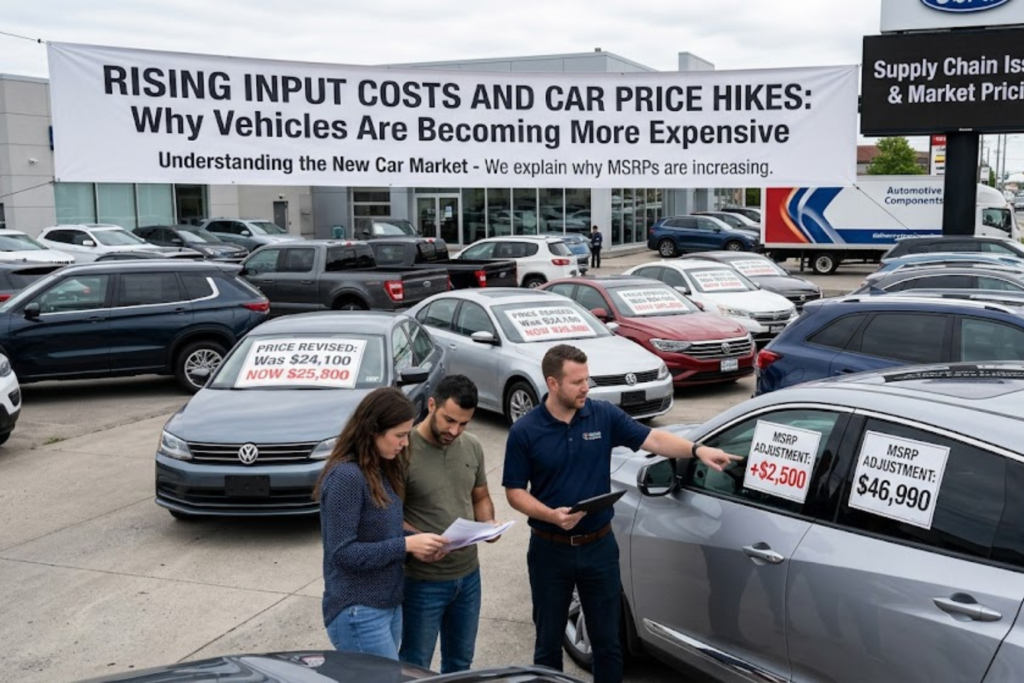
Car prices HIKES are rising because the cost of making vehicles is going up across the supply chain. Higher raw material prices, freight charges, and geopolitical tensions are pushing automakers to increase showroom prices, which is making new cars less affordable for buyers.
Table of Contents
- Why Car Prices Are Rising
- What Is Driving Input Costs
- How Automakers Are Reacting
- Impact on Buyers and the Market
- FAQs
Why Car Prices Are Rising
What is causing the increase?
Car prices are rising mainly because the cost of production is going up. Automakers are paying more for raw materials, shipping, and supply chain operations, and those costs are showing up in the final price of vehicles.
Modern vehicles are more complex
Today’s cars use more electronics, advanced materials, and in some cases battery-related components. That complexity increases the number of cost-sensitive parts and makes the final vehicle more vulnerable to input inflation.
Are companies trying to reduce the damage?
Yes. Many brands are improving sourcing strategies, using more local suppliers, and diversifying their supply chains. These moves help reduce risk over time, but they do not remove short-term pricing pressure.
How does this affect car buyers?
What Is Driving Input Costs
The biggest reason vehicle prices keep climbing is that it now costs more to build, ship, finance, and insure a car than it did a few years ago. Automakers are dealing with expensive materials, more complex electronics, software-heavy features, and a global supply chain that still passes costs down the line. Tariffs and trade frictions also add direct pressure to vehicle and parts pricing, which often reaches consumers quickly.
How Automakers Are Reacting
Automakers are not just absorbing the extra cost; many are adjusting the market in ways that protect margins. They are reducing incentives on popular models, limiting discounts, adding more standard features, and steering buyers toward trims that deliver better profit. In some cases, manufacturers are also cutting back on the cheapest versions of cars because those models are less profitable and harder to produce at scale.
Impact on Buyers and the Market
How does this affect car buyers?
Buyers feel the effect directly through higher showroom prices and higher overall ownership costs. That can push some people to delay purchases, choose smaller models, or consider used vehicles instead.
What happens to the market?
When prices rise too fast, demand can slow because customers become more cautious. Dealers may see slower movement in inventory, while suppliers and automakers both face tighter margin pressure.
Main Cost Drivers
| Cost Driver | What It Affects | Result |
|---|---|---|
| Steel prices | Body panels, chassis, structural parts | Higher production cost economictimes+1 |
| Aluminum prices | Lightweight components and body parts | Higher manufacturing expense business-standard+1 |
| Freight and logistics | Movement of parts and finished vehicles | Higher delivery cost auto.economictimes.indiatimes+1 |
| Geopolitical tension | Sourcing, shipping, and energy supply | Disruption and price volatility faistgroup+1 |
Stakeholder Impact
| Stakeholder | Main Impact | Common Response |
|---|---|---|
| Automakers | Margin pressure | Raise prices or reduce discounts moneycontrol+1 |
| Suppliers | Higher input cost | Reprice contracts or cut costs auto.economictimes.indiatimes+1 |
| Dealers | Slower sales | Use financing offers and promotions |
| Buyers | Lower affordability | Delay purchases or choose lower variants pwc+1 |
What Buyers Are Likely to See
| Market Trend | Likely Effect |
|---|---|
| Higher raw material prices | More car price hikes business-standard+1 |
| Freight instability | More cost revisions auto.economictimes.indiatimes+1 |
| Supply chain disruption | Less pricing stability faistgroup+1 |
| Weak buyer confidence | Slower purchase decisions pwc+1 |
FAQs
Why do car prices rise even when the model is unchanged?
Because production costs can still go up even if the car itself stays the same. Material, transport, and supplier costs often change behind the scenes.
Are electric vehicles affected more by input cost inflation?
Often yes, because EVs depend on batteries, electronics, and specialized materials that are sensitive to global price shifts.
Can automakers keep prices low by cutting profits?
Only for a limited time. If costs stay high, repeated absorption of those costs can damage margins and future investment.
Why do global tensions affect local car prices?
Because car manufacturing depends on international sourcing and shipping. When those networks become unstable, local costs usually rise too.
Will car prices come down soon?
That depends on whether raw material, freight, and supply chain conditions improve. Current reporting suggests price pressure is still active.