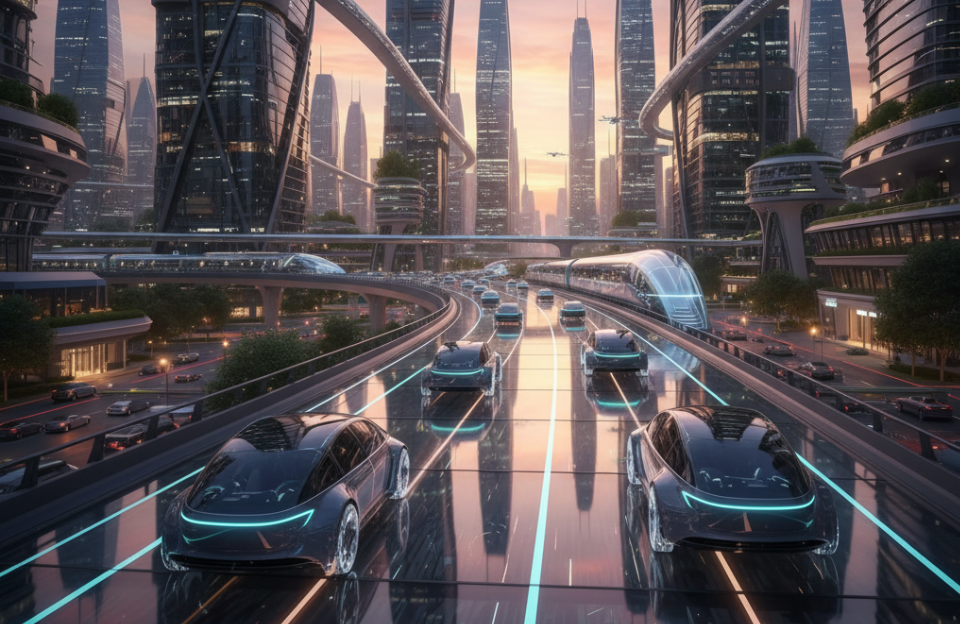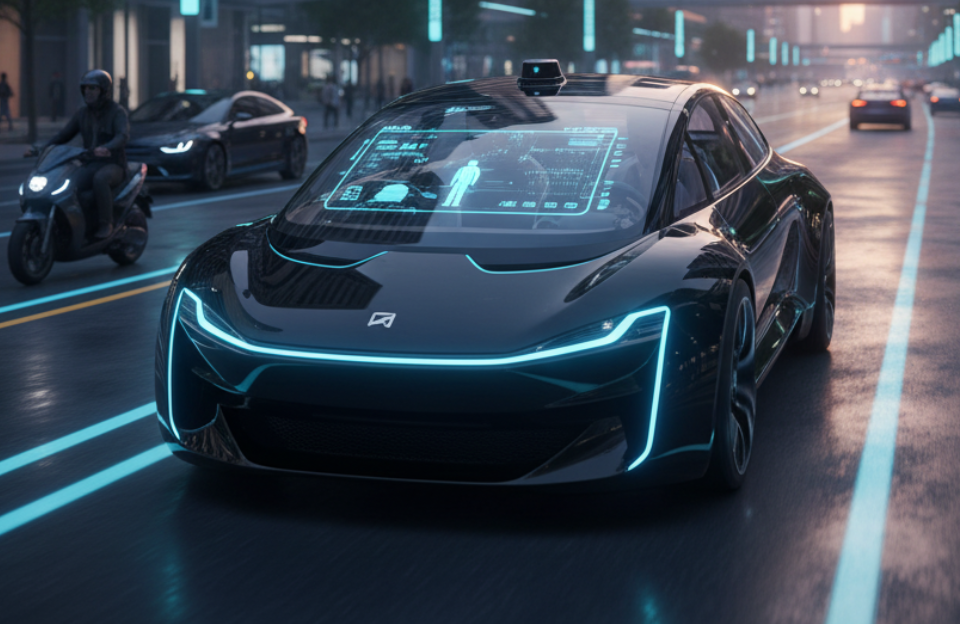

The automotive industry is moving beyond wheels, engines, and power. Today, connectivity drives the development of new systems and technologies that change the vehicles’ relationship with the road and the environment. One of the most recent and exciting technology breakthroughs in the world outlines the importance of vehicle-to-everything communication that allows cars to exchange real-time data with one another, their environment, and a variety of networks. The increased safety of the streets and a lower number of accidents along with smart mobility are the significant implications of this development. In this blog, the author will discuss the specifics of the V2X technology, its advantages, implementation in the Indian automotive industry, and the future of car update news in terms of connected mobility.
Technology Background
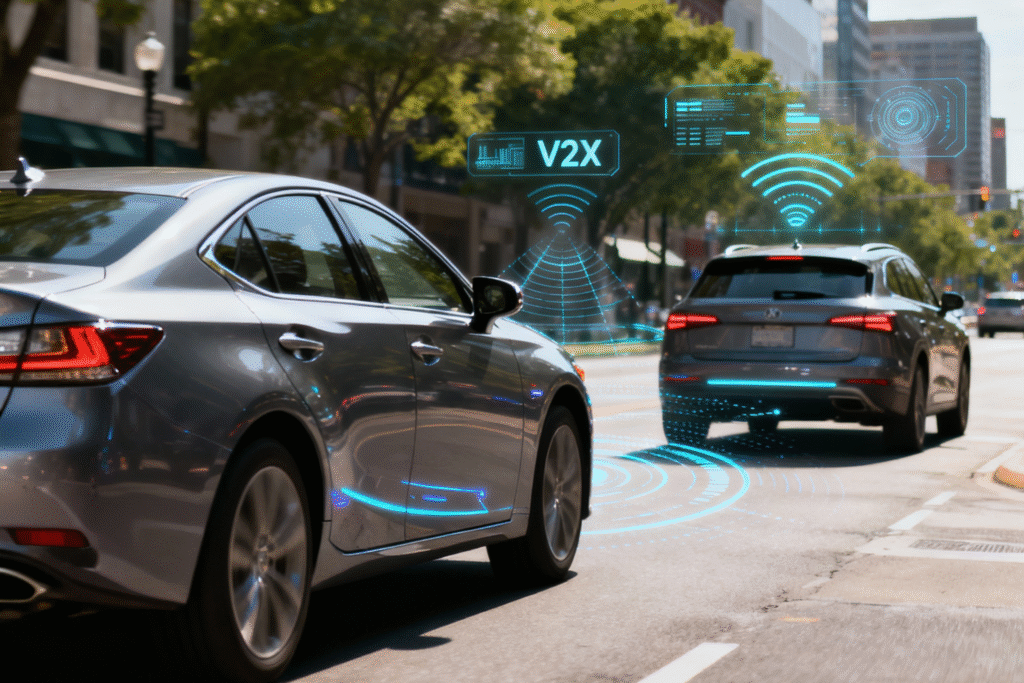
According to car update news by popular engineering sources and updates by automobile companies, V2X is the short term that defines Vehicle-to-Everything communication. It belongs to the system of intelligent transport systems and represents a mechanism of transferring real-time data from one vehicle to another, infrastructure, and people as well as to a variety of networks. V2X can be realized in different forms and include Vehicle-to-Vehicle, Vehicle-to-Infrastructure, Vehicle-to-Pedestrian, and Vehicle-to-Network types of communication. Vehicles are usually linked with one another and the roads with the help of dedicated short-range communication technology or cellular networks like 5G, helping send and receive data about speed, position, and conditions of the roads adjusting similar speeds automatically. The implementation of V2X implies adds each car on the road today to the vast network when each vehicle can share and receive different types of data continuously. In terms of semi-autonomous and autonomous vehicles, V2X is frequently utilized along with AI and other sensor technologies.
What It Is: A Quick Insight
V2X communication is a concept based on sensors, onboard units, or OBUs, and roadside units, or RSUs. Vehicle sensors process input data to determine, for example, road conditions. The OBU performs calculations and sends signals; RSUs may be located along the highway or be a part of any big city’s traffic communication system. Thus, every time a car stops abruptly or when a sensor detects that the road is slippery, the signal is sent. Nearby cars or unmanned vehicles also get simulation, allowing drivers or AI modules to react promptly. In the same manner, alerts are sent to all nearby vehicles about traffic jams, pedestrians on the road, or icy highways. Such a continuous exchange of data reduces the lag in reaction as strongly as possible, decreasing all sorts of road collisions. Since it is heavily reliant on the speed of the modem, the speed of the data, the minimum number of transfers, and the quality of modern encryption, it is clear that the primary shortcoming lies in the quality of AI-driven connections likely to become more stable.
What Types Are There?
There are four types of communications, ensuring safer, greener, and more efficient India autos roads.
- Vehicle-to-Vehicle transmission : allows several cars to interact locally. The main task is mutual awareness and the prevention of this type of traffic accidents.
- Vehicle-to-Infrastructure communication : provides monitoring of traffic lights and road signs, as well as toll systems.
- Vehicle-to-Individuals signal transmission : sends messages from individuals’ gadgets to cars and from the vehicle to handheld or wearable gadgets. This is particularly usual for India autos due to their high street traffic.
- Vehicle-to-Network communication : links all cars to a cloud, allowing over-the-air software changes as required while adding this to the safest and fastest mode of travel.
- Congestion Reduction: Flow-less coordination of the intelligent traffic.
- Time Optimization: Misses and driver exhaustion are reduced with smart navigation.
- Energy Efficiency and Emissions Management: Data-monitored driving patterns are assisting with economy.
- Advanced AV Support: V2X info enables better self-driving safety and decision-making.
Another advantage is the way these features are redefining the mobility rules and keeping the new technologies sustainable. They are solving the problem of the car. It began with the AI use, interpreting the massive data retrieved between vehicles and infrastructure. Machine learning lays the foundation for recognizing matrices and predicting dangers until human drivers won’t be able to respond. AI systems are integrated to make autos act as a whole. Notable innovations are pivotal to the connected mobility field’s future. V2X implementation integrates AI with the automotive world, making cars closer to thinking entities rather than machines. The respective automobile 2023 technologies are signaling another milestone in the era of smart vehicles.
The Concept’s Worldwide Progress
Toyota, BMW, General Motors, and Volkswagen are the principal in the world’s V2X implementation efforts list. The technology has shown amazing results in pilot projects, held in Germany, Japan, the United States, and other markets. The government allocates specific frequency spectrums for driving forces, added to various apps by the leading global OEMs. Those alliances among telecommunications networks and vehicle makers are the foundation for an extensive implementation. The future of the emerging Indian market in this automotive field is promising as digital conversions are enabling easier connectivity.
India’s Means of Achieving Better Connected Vehicle Systems
India’s traffic ecosystems are complex, but Indian autos are incorporating all the needed connected system options. The nationwide IoT and 5G rollout’s commercialization.
Leading brands, including Tata Motors, Mahindra, Hyundai, and Maruti Suzuki, are experimenting with connected car systems that link directly to infrastructure. Smart city in Pune, Delhi, Hyderabad, and Bengaluru are integrating intelligent traffic sensors and adaptive signals. These are some of the significant automobile latest updates in India’s digital transformation journey. V2X adoption enables automotive markets that are ready for the future, thereby supporting both the Make in India and Digital India programs. As consumers become more receptive to cars informations, the interplay between connectivity and automation will dictate new buying preferences.
Use Cases: How Cars “Talk” on Indian Roads
Emergency Vehicle Alerts: Ambulances communicate priority signals over V2X networks for vehicles in front of them to clear the road quickly.
Smart Traffic Management: Idling vehicles cause fuel wastage. V2X systems allow vehicles to have an idea of when traffic lights will change and therefore adapt. Therefore, vehicles spend less time idling and vehicles burn less fuel. In areas where traffic congestion builds up, traffic monitoring systems are installed to manage the density. Communication systems enable the reception of traffic signals by vehicles, which then communicate them to the rest. The vehicles will calculate the amount of time needed to clear a particular point, and the lights will adjust according to the sequence as vehicles will not stop idling anymore.
Collision Avoidance: Vehicles communicate when they will make a quick stop or when bad weather or a pothole is approaching.
Pedestrian Accident Reduction: Smartphone devices can alert pedestrians to an oncoming car, and the car will be notified in case a pedestrian carrying a smartphone crosses the road.
Dynamic Routing: Vehicles navigating the roads at any given time get an update in case of an event and will advise after calculating whether it is better to change the route.
The above use cases reveal that India autos are venturing towards connected, intelligent, and safer drives.
Cybersecurity in V2X Systems
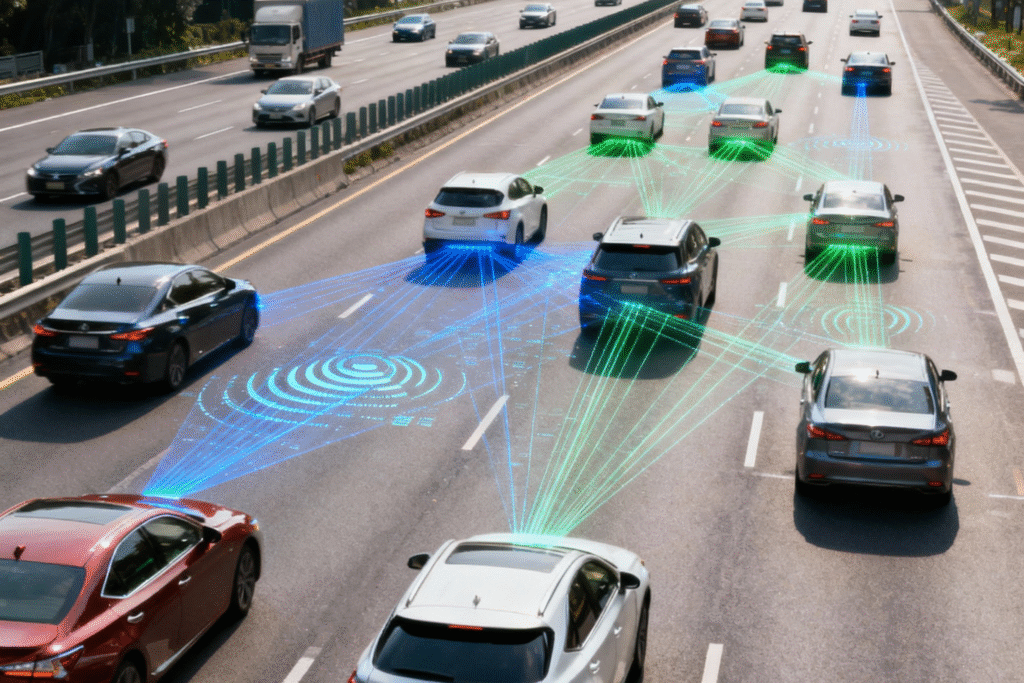
Security of V2X Systems is important due to the sensitive data exchanges. The V2X networks will ensure access permissions, location, and identity are well encrypted through varying keys. Authentication will be via identities that are similar to blockchain-based data protection and decentralized identities to ensure tamper-proof and transparent communication. The relevant industry standards are focusing more on secure digital automotive ecosystems. In this regard, car manufacturers are developing robust firewalls and real-time monitoring systems on communication channels. Therefore, the security components make up significant auto industry updates assisting customers in having confidence in connected cars.
The Road Ahead: V2X and Autonomous Vehicles
V2X is not just an upgrade – it’s a mandatory specification for autonomous automobiles. These self-driven cars will now communicate faster, better, and more reliably with 5G and AI-powered analytics as part of the hardware. They will be fully aware of the roads and responsive enough to adapt to dynamic circumstances. The shared information will empower these fleets to operate with extreme precision, reducing accidents and traffic congestion.
Automobiles in the future will indeed feel like a part of the infrastructure, working in conjunction with traffic signals, guiding systems, and pedestrians. This shift in the auto industry is in line with some of the national governments’ goals for sustainable cities and intelligent mobility. As automobile new updates and features emerge, it is likely that cars will become autonomous and connected. This will soon become the primary talking point in cars new updates and auto industry reports.
The Challenges in Large-scale Vehicle Deployment
The vision may be perfect, but there remain some real challenges:
Smart Infrastructure: It’s going to be a huge challenge to deploy.
Standardization: A universal V2X communication protocol must be made mandatory.
Implementation Costs: Huge, but with more research and scaling, it will stabilize.
Regulations and Awareness: Policymakers and consumers equally need much more education.
Government and the private sector will have to combine forces to overcome these challenges. Doing so is essential for a smooth V2X implementation across the country, freeing up the driver for more urgent responsibilities.
Future Vision: Smart and Cooperative Roads
A city where every car talks with others and the infrastructure, with smart intersections following traffic conditions. These smart cars adjust lanes with ease and confidence, and people freely walk about the roads. This vision is smart mobility. In India autos markets, it is the future of cars new features. Integrating V2X into the electric and autonomous vehicle design is crucial for the automobile sector’s continued success. Digital prospects will be supported by national mobility schedules and smart city strategies.
FAQs
1. What is V2X technology?
V2X (Vehicle-to-Everything) technology enables vehicles to communicate in real-time with other vehicles, infrastructure, pedestrians, and networks. This improves road safety, traffic efficiency, and energy management by exchanging data on speed, position, road conditions, and more .
2. How does V2X improve safety on the roads?
By instantaneously sharing critical information such as emergency vehicle alerts, road hazards, abrupt stops, or pedestrian presence, V2X alerts drivers and autonomous systems early to avoid collisions and reduce accidents .
3. What are the main types of V2X communication?
The four primary types include Vehicle-to-Vehicle (V2V), Vehicle-to-Infrastructure (V2I), Vehicle-to-Pedestrian (V2P), and Vehicle-to-Network (V2N). Each type targets specific connectivity use cases like traffic management, pedestrian safety, and over-the-air software updates .
4. How is V2X being adopted in India?
Leading Indian automakers like Tata Motors and Maruti Suzuki are experimenting with V2X systems, while smart city projects in Pune, Delhi, Hyderabad, and Bengaluru integrate intelligent traffic infrastructure. The rollout of nationwide IoT and 5G networks is accelerating adoption aligned with Digital India initiatives .
5. What are the key benefits of V2X technology?
Benefits include improved traffic congestion management, optimized travel times, energy-efficient driving, better support for autonomous vehicles, and enhanced overall road safety .
6. How does V2X ensure cybersecurity and data privacy?
V2X systems employ strong encryption, authentication protocols akin to blockchain-based models, and real-time monitoring to protect data exchanges. These measures build trust and secure connected car communications against tampering and unauthorized access .
7. What challenges does India face in large-scale V2X deployment?
Challenges include the high cost of smart infrastructure setup, lack of standardized communication protocols, regulatory hurdles, and the need for greater awareness among policymakers and consumers for smooth adoption .
8. What is the future of V2X alongside autonomous vehicles?
V2X will be fundamental for autonomous cars to communicate safely and effectively with their environment, leveraging 5G and AI-powered analytics for precise, timely responses that reduce accidents and improve traffic flow .
Source/References
- ScienceDirect, “A comprehensive overview of vehicle to everything (V2X) communication,” providing technical background and global perspective on V2X
- Wikipedia, “Vehicle-to-Everything,” detailing communication types (V2V, V2I, V2P, V2N), technology standards, and international deployments
- Qualcomm, “V2X Auto Technology | The Future of Autonomous Connectivity,” covering cellular V2X, 5G integration, and benefits for autonomous vehicles
- Keysight, “V2X Vehicle-to-Everything Communication – The Future,” explaining communication modes, 5G role, and key use cases
- IIT Hyderabad and Maruti Suzuki demonstration of V2X applications in India, illustrating the localized implementation and smart city integration
- Tata Elxsi, “India is still some time away from experiencing V2X technology,” analyzing India’s readiness for V2X in urban traffic and IoT rollout
- Economic Times report on Suzuki, Maruti Suzuki, and IIT collaboration showcasing V2X use cases specific to Indian road conditions
- IEEE and Wiley research papers on V2X communication security, encryption, and blockchain-based authentication methods ensuring privacy